Human Essential Assessment

What makes you
irreplaceable
in an AI world?

That is not a rhetorical question. The Human Essential Assessment exists to answer it. With rigour, with honesty, and with a clear development path that is yours alone.

Jungian Type Theory Learning Agility AI Capability Mapping Occupational Research GITO Practice
Explore the framework
What is the HEA?

An assessment built for the moment we are actually in

Most assessments tell you about yourself. The Human Essential Assessment tells you about yourself in relation to where AI is going, and more importantly, where it is not going. That distinction is what makes the difference between development that feels good and development that actually matters.

The HEA draws on three interlocking research streams: Carl Jung's original theory of psychological types, the science of learning agility, and a rigorous mapping of AI capability across occupational domains. Together they answer the question that no single framework can answer alone.

How you naturally orient
Jung's framework maps where your attention goes naturally: how you perceive information and how you evaluate it. This is your starting point, not your ceiling.
How well-equipped you are to grow
Learning agility research tells us whether and how effectively you can develop beyond your natural orientation. That matters more than ever right now.
Where AI is going and where it is not
The Anthropic Economic Index and AI adoption research map the capability boundary with enough precision to make genuinely strategic development decisions.

02
The Foundations

Two axes. Four orientations.
One developmental map.

Carl Jung gave us something rare: a framework for how the mind actually orients itself. Not a personality label or a fixed identity, but a living map of how you take in the world and make sense of it. The HEA is built on Jung's original 1921 work, not its later derivatives.

At its core are two independent axes. The Perception axis describes how you gather information: through what is concrete, present, and observable (Sensing), or through what is abstract, patterned, and possible (Intuition). The Judgment axis describes how you evaluate that information: through objective, logical analysis (Thinking), or through values, relationships, and human impact (Feeling). Click any quadrant to explore what it means.

← Sensing
Perception Axis
Intuition →
← Thinking
Judgment
Feeling →
The developmental insight: The quadrant diagonally opposite your natural orientation is Jung's inferior function: the least developed and most effortful mode. Individuation is the lifelong movement toward integrating it. This is not a weakness to hide. It is the primary site of your growth.
The Second Foundation

Learning Agility: the meta-capability

Jung tells you where your natural orientation sits. Learning agility is the ability to learn from experience and apply it effectively in new and unfamiliar situations. It tells you how well-equipped you are to develop away from that orientation. In an AI-shifted world where the capability boundary moves continuously, this is not a supporting capability. It is the central one.

Based on the research of Lombardo, Eichinger, De Meuse and colleagues, the HEA measures four dimensions of learning agility, each of which maps onto the Jungian framework in a revealing way.

Mental Agility
Comfort with complexity, tolerance of ambiguity, ability to reframe problems. Maps most naturally onto Intuition and Thinking. Often the hardest stretch for strongly Sensing-Thinking oriented individuals.
People Agility
Reading others accurately, adapting interpersonal approach, building relationships across difference. Maps onto Feeling, and most clearly exposes the development gap for strongly Thinking-oriented individuals.
Change Agility
Experimentation, curiosity, comfort initiating change. Maps most strongly onto Intuition: the willingness to move beyond the concrete and known toward possibility and the not-yet-defined.
Results Agility
Maintaining performance under pressure in novel situations. Draws primarily on Sensing and Thinking for execution, but requires all four functions when situations are genuinely unprecedented.
The convergence signal: The learning agility dimension you find most natural will tend to align with your dominant Jungian function. Where type theory and learning agility both point toward the same developmental edge, that convergence is the HEA's most confident and most actionable finding.
What neuroscience adds

Your brain grows when challenged.
That is not a metaphor.

Here is something worth knowing about your brain: it does not stop growing when you reach adulthood. For most of the twentieth century, scientists believed it did. The old idea was that your brain was essentially fixed once you were grown, and the patterns you had formed were the ones you kept. That idea is now well and truly overturned. We know today that the adult brain continues to form new connections, strengthen useful pathways, and build genuinely new capacity throughout life. This is the current scientific consensus, not a self-help claim.

What is really interesting is what triggers that growth. Familiar, routine work within your natural strengths reinforces what you already have. It does not build new capacity. What actually activates the brain's ability to rewire and grow is the same kind of experience that learning agility research independently identifies as developmental: genuinely novel situations, unfamiliar problems, moments that require stepping outside your habitual patterns.

A landmark review in Nature Reviews Neuroscience (Uddin, 2021) mapped the brain networks supporting cognitive flexibility and found something directly relevant here: those networks are trainable. They grow stronger through deliberate exposure to complexity and change, not through repetition of the already known.

There is also an emerging molecular dimension worth naming. The brain produces a protein called BDNF that acts as a biological signal for learning and adaptation. Research shows it is activated in the regions responsible for memory and judgment when you encounter genuine cognitive challenge. Think of it as the brain's chemical way of saying: this matters, build something here. The direct link in healthy working adults is still being established, so we name it as emerging evidence, not settled fact.

Research on what keeps the brain sharp across a lifespan consistently points to one factor above others: occupational complexity. Working on things that genuinely challenge you is what maintains cognitive flexibility over time. Routine work within your comfort zone does not.

Now consider what is happening in most workplaces right now. AI is absorbing the procedural, analytical, and repetitive work. What it leaves behind is disproportionately complex, ambiguous, and cross-functional. This is not just a change in job content. According to the neuroscience, it is a change in the conditions that either maintain or erode your cognitive capacity over time. Developing toward your less-preferred functions is not simply good career advice. It is neurologically adaptive.

How challenge changes your brain
COMFORT ZONE GROWTH ZONE Existing paths strengthen Routine work · AI compatible you New pathways form with each genuine challenge New connections form Novel challenge · Neuroplasticity activated
Familiar zone Growth zone AI territory
Established finding
Adult neuroplasticity is lifelong
Gazerani, Brain Research, 2025
Established finding
Cognitive flexibility networks are trainable
Uddin, Nature Reviews Neuroscience, 2021
Emerging evidence
BDNF as molecular signal of novel-challenge learning
Direct workplace link still being established
Reasoned inference
Occupational complexity drives cognitive maintenance
Neyra Chauca et al., MDPI Neurology International, 2026

03
The AI Capability Landscape

Where AI reaches,
and where it does not.

AI does not enter every domain of human capability equally. It enters from the centre, from the most procedural and least differentiated zone, and radiates outward. The outer corners of each quadrant represent the purest, most irreducibly human expression of each function pair. That is precisely where the HEA focuses your development.

Each quadrant below shows two layers: what AI is theoretically capable of, and what is actually being deployed at scale today. The gap between them is not a technical limitation. It is structural: driven by accountability requirements, genuine relational trust, and tasks that remain outside AI's functional reach entirely. Click any quadrant to explore the data.

← Sensing (S)
Perception Axis
Intuition (N) →
← Thinking (T)
Judgment
Feeling (F) →
Theoretical ceiling
Observed deployment today
Gap = adoption friction, structural not technical
The Core Insight

Sustainable development is not a choice between AI skills and human skills.

The most common framing misses the point: whether to "adapt to AI by learning the tools" or to "develop the human skills AI cannot replicate." Both matter. Neither alone is sufficient. The professionals who will thrive are those who use AI to dramatically reduce cognitive load in procedural and analytical work, while simultaneously deepening their capability in the domains AI cannot reach. The combination is not additive. It is exponential.

⚙️
AI as cognitive relief
Procedural analysis, data synthesis, compliance logic: let AI carry this. Freeing your attention from the ST domain is not a loss. It is a gift.
🧭
Human as irreplaceable depth
Purpose-connection, values-judgment, genuine relational trust, meaning-making: these remain almost entirely outside AI's reach. Developing here is where durable advantage lives.
The combination is the strategy
The HEA maps exactly where you are on this journey and what, specifically, your development path looks like given your natural orientation and learning agility profile.

03b

Where you should develop in AI.

Two principles, working together. Professionally: let AI handle what you already do well, so your attention moves to higher-value work. Personally: use that freed capacity to develop toward the quadrant AI reaches least, which is also where your long-term value is most durable.

Professional · Free up time

Use AI to automate your analytical and procedural work

ST-dominant professionals are best positioned to extract immediate productivity from AI. Let it handle data analysis, compliance checks, reporting, and process documentation: tasks AI performs most capably. This is not replacing your strength; it is deploying it more efficiently.

The professional payoff: the hours you reclaim become available for work requiring human judgment, stakeholder navigation, and purpose-connection: work that compounds in value as AI automation deepens.

Personal · Develop toward

Grow into NF territory: purpose, meaning, and relational presence

NF is where AI has the smallest footprint and where ST-dominant individuals have the most developmental headroom. This does not mean becoming someone you are not. It means adding range: connecting your analysis to why it matters for people, listening before presenting conclusions, and developing the relational trust that makes your work get implemented rather than just acknowledged.

This is also what neuroscience predicts: the genuine novelty of relational and values-based work activates neuroplasticity in ways that routine analytical work no longer does.


04
Occupational Research

What the research shows
about your field.

We have mapped the evidence across 22 broad occupational categories. Each one is positioned on the Jungian perception and judgment axes based on available type research, with bubble size showing AI theoretical task coverage (Eloundou et al. β measure, Anthropic Economic Index) and colour indicating the quality of Jungian research available.

There is a structurally important coincidence in this data: the occupations most exposed to AI automation are precisely the ones where the Jungian type research is richest. This makes the translation from theoretical mapping to practical development guidance most reliable exactly where it is most urgently needed. Hover or tap any bubble to explore.

← Sensing (S) Thinking (T) ↑ Intuition (N) →
ST NT SF NF
↓ Feeling (F)
High type research coverage
Moderate coverage
Sparse / none
Bubble size = AI theoretical coverage  ·  Dashed outline = introvert-dominant
Hover over any bubble to see the type mapping confidence, AI coverage, and research quality for that occupational category.
Key finding: Reliable type-to-development translation is feasible for roughly 55% of occupational categories, precisely those under the highest AI pressure. For physical trades and personal service roles (lower-left), both AI coverage and type research are sparse; task-level analysis is more appropriate there than quadrant mapping.

05
Your Development

What this means for you, specifically.

Frameworks only matter when they translate into something concrete and personal. Here is what the HEA looks like applied to a single individual, and what it reveals about the development decisions that matter most right now.

K
Kai
Senior Operations Analyst · 12 years · Manufacturing

Kai is precise, methodical, and highly reliable. Teams trust his analysis because it is always grounded in evidence and delivered on time. He finds comfort in structure and is at his best when a problem has clear parameters and measurable outcomes.

He is less comfortable in conversations that become values-based or emotionally charged. Strategic ambiguity makes him anxious. He has never seen himself as a people person, and his career has been built around precision and process work that has consistently been rewarded.

Cognitive coverage
Precise analysis
84%
Strategic thinking
55%
Relational care
25%
Purpose and meaning
13%
Learning agility: Getting results under pressure is strong · Thinking in new ways is moderate · Reading people is low · Embracing change is very low
Cognitive coverage map
Precise analysis
Strategic thinking
Relational care
Purpose and meaning
The development insight

The work Kai is best at is also the most exposed to AI.

Twelve years of career success have been built on precise analysis, clear process, and decisions backed by data. These are genuine strengths. They have created real value and will continue to.

But they are also exactly what AI handles most readily. The Anthropic Economic Index shows that roughly 88% of the specific tasks in Kai's current role sit in this territory. Not gone, but exposed. The trajectory is clear.

This is about adding range, not changing who he is.

Kai does not need to become someone he is not. His precision stays. The development question is: what does he add to it that AI cannot replicate?

In practice, this looks like: listening more deliberately before presenting conclusions. Being curious about what a stakeholder actually cares about, not just what they asked for. Connecting his analysis to why it matters for the people involved. These are learnable, specific behaviours, not personality transplants.

In practice: what AI frees up

Kai deploys AI to handle data consolidation, variance reporting, compliance documentation, and first-draft process maps. Tasks that previously consumed 60 to 70 percent of his week now take a fraction of that time. His attention is now available for the conversations that actually determine whether his analysis gets acted on.

In practice: where he develops

Asking what a stakeholder actually cares about before presenting. Connecting findings explicitly to what they mean for the people involved. Following up after decisions rather than treating delivery as the endpoint. None of this is a personality change. It is a deliberate extension of his range into territory AI will not reach.

What the neuroscience adds for Kai specifically

AI is not just changing his job. It is changing the conditions for his cognitive growth.

If AI absorbs the structured analysis work that fills Kai's day, what remains is disproportionately complex, ambiguous, and relational. The neuroscience of cognitive reserve tells us that it is precisely that kind of challenge that maintains mental flexibility across a lifespan. Routine work within your strongest mode does not. This means that for Kai, developing relational and purpose-centred capability is not simply good career advice. It is neurologically adaptive. Practically, this means the conversations Kai now needs to navigate, the stakeholder alignment, the cross-team complexity, the ambiguous briefs, are not just harder versions of his existing job. They are genuinely different cognitive work. The HEA identifies what that work requires, and builds a development path that starts from exactly where Kai is today.

📊
Where Kai is today
Expert in precise analysis. His strongest capabilities are also those most exposed to AI. He is building on what made his career, but in terrain AI is entering fast.
🧭
What the HEA maps
The specific relational and purpose-centred development his role will increasingly demand, and that AI cannot provide on his behalf.
The outcome
An analyst who uses AI to handle the mechanics, and invests the freed capacity in the relational and purpose-centred work that builds genuine trust. His recommendations get implemented, not just because they are accurate, but because colleagues believe in the person behind them.

06
For Organizations and Teams

Development that compounds
across your whole organization.

For individuals, the Human Essential Assessment clarifies a development path. For organizations, it does something more. It provides a shared language for understanding how different cognitive orientations contribute to and sometimes constrain the organizational lifecycle: what needs to develop where, at what pace, and why.

MindMagine's GITO approach (Govern, Innovate, Transform, Optimize) frames organizational development as a perpetual, compounding loop rather than a series of interventions. At the centre of that loop are four human enablers: Behavior Management, Collaboration, Leadership, and Motivation. The HEA is designed to diagnose and develop each of them, with Jungian type and learning agility as the underlying architecture.

As AI takes over increasing amounts of procedural and analytical work, the competitive advantage of any organization will be determined by the quality of what AI cannot replicate: the behavioral discipline, the collaborative trust, the leadership judgment, and the intrinsic motivation of the people doing the work. The HEA is built to develop exactly this.
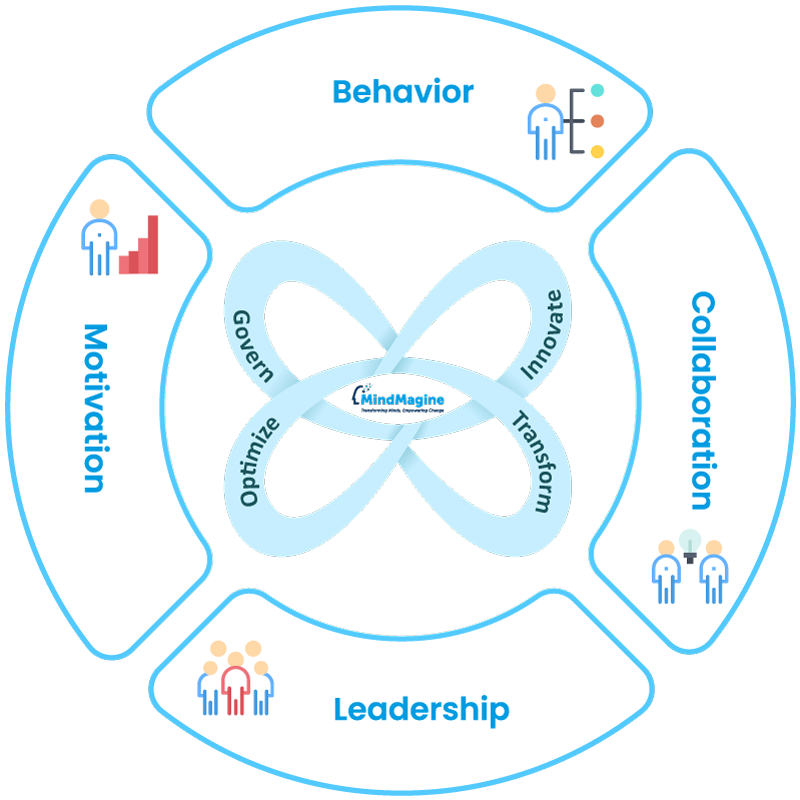
GITO Human Enablers
Enabler 01

Behavior Management

ST NT SF NF Se Ti Ni Fe Si 01 Te 02 Fi 03 Ne 04 1 · Si · Experience 2 · Te · Structure 3 · Fi · Values 4 · Ne · Possibility Draws on proven experience, structures systematically, checks personal values, opens to new possibilities.

Think about the last time your organization introduced a new process or policy. Within three months, what percentage of people were genuinely following it? In most organizations, the honest answer lands somewhere between 30 and 50 percent. Not because people are resistant by nature. Behavior change is neurologically hard, and most implementation plans treat it as an afterthought.

The human brain is wired for efficiency. Established habits are encoded in the basal ganglia as near-automatic routines. New behaviors require effortful prefrontal processing, and under pressure people revert. David Rock's SCARF model adds a further dimension: perceived threats to status, certainty, autonomy, relatedness, or fairness actively suppress the flexible thinking that adoption requires. Effective behavior change must address this first.

The HEA's contribution here is diagnostic specificity. A strongly Sensing-Thinking oriented team will require different reinforcement conditions than an Intuition-Feeling oriented one. The behavioral resistance patterns, the cue-routine-reward designs that work, and the SCARF-relevant framing that reduces threat response: all of these need to be calibrated to actual cognitive orientation, not assumed to be universal.

Habit Formation
New behaviors become automatic only through repeated execution in consistent contexts with clear cues and rewards. The HEA identifies which contexts activate each cognitive orientation most reliably.
SCARF Calibration
Sensing-dominant teams experience threat differently from Intuition-dominant ones. Effective change communication must be mapped to the actual orientation profile of each team, not applied uniformly.
Visible Reinforcement
Recognition systems, feedback loops, and performance dashboards need to be designed for the dominant cognitive mode. What signals progress to an ST-oriented team differs from what works for an NF-oriented one.
Adoption Tracking
Behavior adoption is tracked through observable metrics, not self-reporting. The HEA baseline creates a pre-post measurement framework that makes behavior change legible at both individual and team level.
In AI-shifted organizations: As AI takes over ST-domain tasks (analysis, compliance, reporting), the behavioral challenge shifts. Teams must develop new habits around AI-assisted workflows while preserving the human judgment that makes AI output trustworthy and usable. This requires deliberate behavior design, not just tool rollout.
🤝
Enabler 02

Collaboration

ST NT SF NF Si Te Ne Fi Fe 01 Ni 02 Se 03 Ti 04 1 · Fe · Harmony 2 · Ni · Insight 3 · Se · Presence 4 · Ti · Analysis Creates harmony and rapport, applies long-range insight, stays grounded in present detail, applies internal logical analysis.

When was the last time someone in your organization said, out loud, "I disagree with this direction, and here is why" and the room genuinely welcomed it? The answer to that question tells you more about your collaboration health than any engagement survey.

Effective collaboration requires psychological safety: the shared belief that a team is safe for interpersonal risk-taking. But psychological safety does not look the same across all cognitive orientations, nor across all cultural contexts. In high power-distance environments common across APAC, open disagreement in group settings is often avoided because the cultural norm is to express dissent indirectly. Sensing-Feeling oriented teams express relational trust differently from Intuition-Thinking oriented ones. Neither is more or less collaborative. They simply require different conditions to collaborate well.

The HEA maps the collaboration blockers specific to each orientation pair, and designs facilitation approaches that create space for honest input without requiring anyone to publicly challenge authority or seniority. The cognitive diversity across a team is not a complication to manage. It is the source of the team's adaptive capacity. The challenge is designing the conditions that allow each orientation to contribute at full strength.

Cross-function Handoffs
Handoff breakdowns often happen at quadrant boundaries, where Sensing-Thinking delivery meets Intuition-Feeling reception, or vice versa. The HEA makes this visible so teams can design across it deliberately.
Dissent Architecture
Structured facilitation creates channels for honest input calibrated to the orientation profile of each team and the cultural context of the organization, not applied uniformly.
Cognitive Diversity
Teams whose orientation profiles span all four quadrants outperform homogeneous ones on adaptive tasks. The HEA identifies gaps in team coverage and the collaboration practices needed to bridge them.
Relational Trust
AI cannot produce genuine relational trust. Research is clear: users consistently rate AI relational support as less sincere even when the wording is identical to human output. Developing this capability is non-delegable.
In AI-shifted organizations: As AI takes over analytical communication (summaries, reports, routine correspondence), the SF domain of genuine human connection becomes the differentiator in client relationships, team cohesion, and talent retention. Developing collaboration capability here is a direct competitive advantage.
🧭
Enabler 03

Leadership

ST NT SF NF Se Te Ni Fi Ne 01 Ti 02 Fe 03 Si 04 1 · Ne · Possibility 2 · Ti · Framework 3 · Fe · Alignment 4 · Si · Experience Generates possibilities, builds logical frameworks, aligns through shared values, grounds in proven experience.

A leader once said, in an engagement session: "Why do I need to change? The strategy is working and I'm hitting my numbers." It is a fair question. And it is exactly the wrong frame for leading transformation. The leader hitting their numbers by directing rather than enabling is building a team that performs to their ceiling, not to its own.

Leadership development through the HEA equips leaders to embody the full organizational lifecycle: setting clear direction (Govern), modeling curiosity and experimentation (Innovate), guiding their teams through genuine uncertainty (Transform), and maintaining the discipline of continuous improvement (Optimize). This is not a style prescription. It is a cognitive range requirement.

The NT quadrant, which combines Intuition with Thinking, is where strategic leadership naturally sits. But effective leaders must be capable of genuine Sensing-Feeling moments: presence, relational attunement, values-grounded judgment. The HEA maps exactly where each leader's range currently extends, and what the priority development looks like given both their natural orientation and their organizational role.

Strategic Range
Effective strategy requires both pattern-recognition (N) and logical rigor (T). The HEA identifies where leaders over-rely on one at the expense of the other, and designs the development path to address it.
Distributed Accountability
In APAC high power-distance contexts, trust precedes delegation. Leadership coaching introduces distributed decision-making practices that are credible within existing cultural logic rather than imported wholesale.
Behavior Modeling
Leaders are observed by their teams constantly. The gap between stated values and modeled behavior, especially under pressure, is the most powerful determinant of organizational culture. The HEA makes this gap legible.
Feedback Quality
Leaders give feedback that reflects their own dominant function. NT-oriented leaders tend toward systemic critique; SF-oriented leaders toward relational validation. Neither alone serves team development. Both are needed.
In AI-shifted organizations: AI is theoretically capable of strategic pattern modelling. But the adoption gap is enormous: executives structurally resist delegating judgment and accountability. This is not obstruction. It is the appropriate preservation of human leadership in the NT domain. The HEA develops the judgment quality that makes this resistance productive rather than regressive.
Enabler 04

Motivation

ST NT SF NF Se Ti Ni Fe Fi 01 Ne 02 Si 03 Te 04 1 · Fi · Values 2 · Ne · Exploration 3 · Si · Experience 4 · Te · Action Connects to deep values, explores ideas and futures, anchors in experience, converts to systematic action.

The most common motivation failure in transformation programmes is the confusion between compliance and commitment. People can comply with a new way of working while being entirely uncommitted to it. Compliance fades the moment the inspection ends. Commitment sustains itself because the person understands why the change matters and feels genuine ownership of the outcome.

The HEA's motivation framework draws on Self-Determination Theory (Deci and Ryan, 1985), which identifies three core intrinsic drivers underlying sustained high performance: purpose (why the work matters beyond personal reward), autonomy (meaningful ownership of how it gets done), and mastery (the ongoing development of skill and capability). These are not universal in their expression. NF-oriented individuals connect to purpose through meaning and values; ST-oriented individuals through demonstrated competence and reliable results. Both are genuine, and both need to be activated.

The NF quadrant, combining Intuition with Feeling, is where purpose-connection, meaning-making, and intrinsic motivation activation are at their most natural and powerful. It is also AI's weakest domain. This is not a coincidence. It is the core structural insight of the HEA: the functions most essential to sustained human motivation are precisely the ones that AI cannot simulate with any depth.

Purpose Architecture
Purpose-driven goal setting requires understanding how each person's dominant function connects to the larger organizational direction. The HEA maps this individually and aggregates it at team level.
Autonomy Design
Genuine ownership means control over how the work gets done, not just what gets done. Empowerment initiatives need to be calibrated to the orientation of each team member to feel real rather than performative.
Mastery Pathways
As AI absorbs the most repetitive elements of each role, mastery must be redefined. The HEA identifies where the new mastery frontier sits for each orientation and designs the development path to reach it.
Retention Through Change
Motivation that is extrinsically sourced spikes in transformation and collapses afterward. The HEA identifies the intrinsic motivation architecture of each team and designs the conditions that sustain it through change.
In AI-shifted organizations: AI generates purpose-language fluently. What it cannot produce is the lived sense that one's work matters, that one is genuinely growing, that one belongs to something real. These NF-domain experiences are the most durable source of organizational commitment, and the most at risk when AI adoption is handled as a purely technical transition.
Research references — click to expand
Learning Agility
Lombardo, M.M. and Eichinger, R.W.
High potentials as high learners
Human Resource Management, 39(4), 321-329 · 2000
doi.org/10.1002/hrm.2000
De Meuse, K.P., Dai, G., and Hallenbeck, G.S.
Learning agility: A construct whose time has come
Consulting Psychology Journal, 62(2), 119-130 · 2010
doi.org/10.1037/a0019988
De Meuse, K.P.
Learning agility: Its evolution as a psychological construct and its empirical relationship to leader success
Consulting Psychology Journal, 69(4), 267-295 · 2017
doi.org/10.1037/cpb0000100
De Meuse, K.P.
Learning agility: Could it become the G-factor of leadership?
Consulting Psychology Journal, 74(3), 215-236 · 2022
doi.org/10.1037/cpb0000216
Jungian Type Theory
Jung, C.G.
Psychological Types (Collected Works, Vol. 6)
Rascher Verlag, Zurich · 1921 · English translation: Princeton University Press, 1971
press.princeton.edu
Schaubhut, N.A. and Thompson, R.C.
MBTI Type Tables for Occupations
CPP Inc. · 2008
themyersbriggs.com
AI and Occupational Exposure
Eloundou, T., Manning, S., Mishkin, P., and Rock, D.
GPTs are GPTs: Labor market impact potential of LLMs
Science, 384(6702), 1306-1308 · 2024
doi.org/10.1126/science.adj0998
Anthropic
Anthropic Economic Index
2025
anthropic.com/news/the-anthropic-economic-index
McKinsey Global Institute
The State of AI in 2024
McKinsey and Company · 2024
mckinsey.com
Neuroscience and Motivation
Uddin, L.Q.
Cognitive and behavioural flexibility: Neural mechanisms and clinical considerations
Nature Reviews Neuroscience, 22(3), 167-179 · 2021
doi.org/10.1038/s41583-021-00428-w
Gazerani, P.
The neuroplastic brain: Current breakthroughs and emerging frontiers
Brain Research, 1858, 149643 · 2025
doi.org/10.1016/j.brainres.2025.149643
Neyra Chauca, J.M. et al.
Neuromarkers of adaptive neuroplasticity and cognitive resilience across aging
MDPI Neurology International, 18(1), 10 · 2026
doi.org/10.3390/neurolint18010010
Deci, E.L. and Ryan, R.M.
Self-determination theory and the facilitation of intrinsic motivation
American Psychologist, 55(1), 68-78 · 2000
doi.org/10.1037/0003-066X.55.1.68